Human Review vs Full Automation in AI Workflows: A Practical Guide
Why this matters
Teams building AI-enabled systems face a common choice: let models run end-to-end without human intervention, or insert human reviewers at one or more steps. The decision affects accuracy, speed, cost, compliance, and trust. This guide helps you choose and build the right approach for your business systems.
Basic definitions
- Full automation: AI models and agents perform the entire workflow without human checks in the loop before final output.
- Human review (human-in-the-loop): Humans verify, edit, or approve AI outputs either before they reach the end user or after the fact as a safety measure.
Both approaches can coexist inside a single system. The practical question is where and how.
When full automation makes sense
Consider full automation when all of the following are true:
- Low risk of harm from mistakes (e.g., internal categorization, non-critical routing).
- High volume and need for speed or constant availability.
- Stable, well-understood inputs and outputs.
- You have reliable automated monitoring and rollback mechanisms.
Benefits:
- Faster throughput and lower per-item cost.
- Predictable latency and scale.
Drawbacks:
- Risk of undetected errors if monitoring is weak.
- Harder to handle rare edge cases out of distribution.
When to prefer human review
Use human review when any of these apply:
- Decisions can cause legal, financial, safety, or reputational harm.
- High variability in inputs or frequent edge cases.
- Regulatory or compliance requirements demand human oversight.
- You need explainability or a recordable audit trail of decisions.
Benefits:
- Better handling of ambiguity and nuance.
- Easier to meet compliance and accountability needs.
Drawbacks:
- Higher cost and slower turnaround.
- Potential for human error or bias unless processes are well-designed.

A decision checklist (simple)
Ask these questions for each workflow:
- What are the consequences of a wrong output? (low / medium / high)
- How predictable are the inputs and outputs?
- What is the acceptable latency for the task?
- What level of auditability and traceability is required?
- What budget and staffing are available for human review?
If consequences are high or predictability is low, bias toward human review or a hybrid model.
Hybrid patterns that work
You don't need to choose exclusively. Common, practical hybrid patterns:
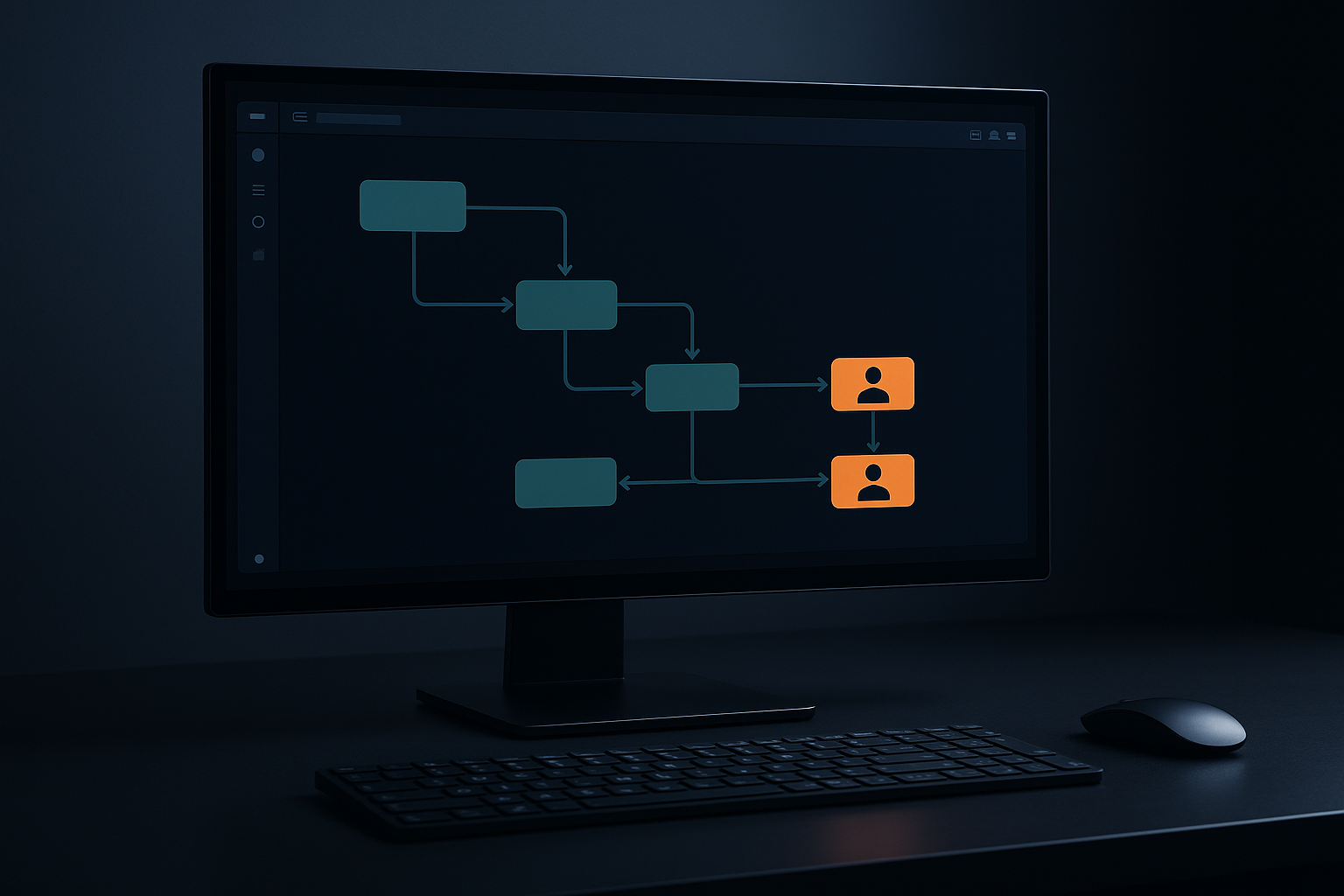
- Gatekeeper review: AI handles everything, but flagged items (confidence below threshold or specific categories) route to humans.
- Sample auditing: Humans review a statistical sample of outputs to detect drift or systematic errors.
- Escalation flow: AI attempts first; when uncertain, it escalates to a human with context and suggested actions.
- Human-on-demand: Humans intervene only during exceptions or high-value cases.
Each pattern trades cost, speed, and safety differently. Use a combination depending on segments of your pipeline.
Implementing hybrid workflows (practical steps)
- Instrument confidence and explainability: expose model confidence and the signals behind decisions.
- Define thresholds and rules: map confidence levels to automated vs human paths.
- Design human tasks for speed and clarity: pre-fill context, show suggested edits, and capture reasons for overrides.
- Build audit trails: log model inputs, outputs, reviewer actions, timestamps, and versioning of models.
- Measure quality and cost: track error rates before and after review, average review time, and cost per review.
- Iterate: use reviewer corrections to retrain models and adjust routing rules.
Monitoring and metrics to use
Key metrics to track:
- False positive / false negative rates where applicable.
- Model confidence distribution and how it maps to reviewer load.
- Time-to-resolution for human-reviewed items.
- Review precision: how often reviewers correct vs approve.
- Downstream impact: customer complaints, compliance incidents, or operational errors.
Set service-level objectives (SLOs) for automated accuracy and for human review turnaround.
Tooling and team practices
- Use tools that make reviewer work efficient: contextual views, shortcuts, and bulk actions.
- Automate as much pre- and post-processing as possible to reduce human cognitive load.
- Train reviewers on the system and provide continuous feedback loops between engineers and reviewers.
- Keep model and rules versioned so you can compare performance across changes.
A short example (typical workflow)
- AI extracts information from documents and fills a structured form.
- If confidence > 0.9, auto-approve. If 0.7–0.9, route to fast human review with pre-filled suggestions. If < 0.7, route to detailed review or reject for manual processing.
- Reviewer accepts or corrects. Corrections feed back into model training and thresholds are adjusted monthly.
This pattern balances speed and safety while providing data to improve automation.
Common pitfalls and how to avoid them
- Over-reliance on a single confidence metric: combine metrics (confidence, input novelty, rule-based signals).
- Poorly designed review interfaces: make reviewer actions fast and unambiguous.
- Lack of feedback loops: without retraining, human review becomes a permanent expense rather than an improvement mechanism.
- Not accounting for scale: review capacity planning should be part of feature design.
Checklist before switching to full automation
- Do you have reliable monitoring and rapid rollback?
- Are edge cases well-understood and handled safely?
- Have you quantified the business impact of errors?
- Are compliance and audit requirements satisfied?
- Is there a plan to monitor drift and retrain models?
If you can’t answer yes to these, prefer hybrid or human review.
Conclusion
Choosing between human review and full automation isn't binary. Start by assessing risk, cost, and user impact. Use hybrid patterns to get the benefits of automation while retaining human judgment where it matters most. Instrument everything so you can shift responsibility safely as models improve.
Practical takeaway: start with a simple hybrid pattern—automate high-confidence cases, route uncertain cases to fast human review, log everything, and continuously retrain models from reviewer corrections.
