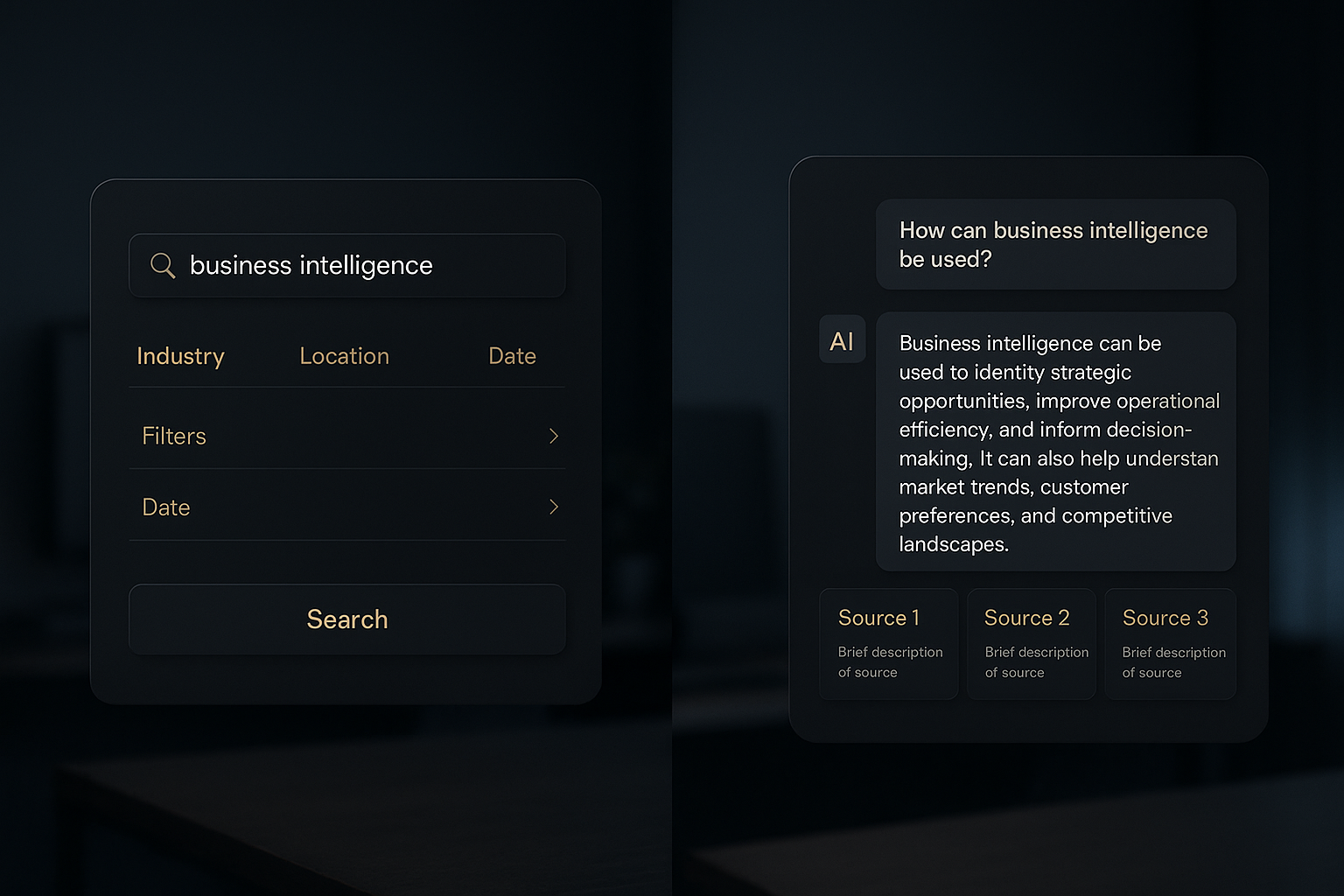
Old School Search vs AI Search What Actually Changed
Search is changing visibly: long keyword queries and filter-heavy pages are giving way to chat-style discovery and single-answer summaries. That feels like a hard break. In practice, some fundamental problems have been solved differently — but many old rules still matter.
This post compares the two models, explains what genuinely changed, and gives practical guidance for teams building or adopting search with conversational AI.
Quick summary
- Old-school search: explicit keywords, filters, ranked lists, and visible controls. Good at precise retrieval and predictable behavior.
- AI/conversational search: natural language queries, context, summaries, follow-ups, and generated answers. Good at synthesis and reducing friction.
- What changed: input style, expectation of synthesis, and the need for grounding (citing sources and provenance).
- What still matters: metadata, indexing quality, clear filters, iterative refinement, relevance metrics, and user control.
How keyword search historically worked (and why it lasted)
- Users express intent with concise terms, operators, and filters.
- Systems rely on inverted indexes, ranking signals (TF-IDF, BM25, later learning-to-rank), and explicit metadata.
- Results are lists with snippets and links; users scan and decide.
Why it endured:
- Predictable: users learn how queries map to results.
- Auditable: you can trace why a result ranked well (matching keywords, metadata).
- Efficient for precise retrieval: when you know what you want, keywords + filters get you there fast.
What conversational AI changes
- Natural input: users type or speak questions in plain language instead of craftily tuning keywords.
- Synthesis: systems summarize multiple sources into an answer instead of showing a ranked list.
- Context and memory: follow-ups can rely on previous turns to refine intent without rewriting queries.
- Multimodal and step automation: images, documents, workflows and actions can be referenced or triggered directly.
These are real productivity improvements for discovery, exploratory research, and workflows where synthesis saves time.
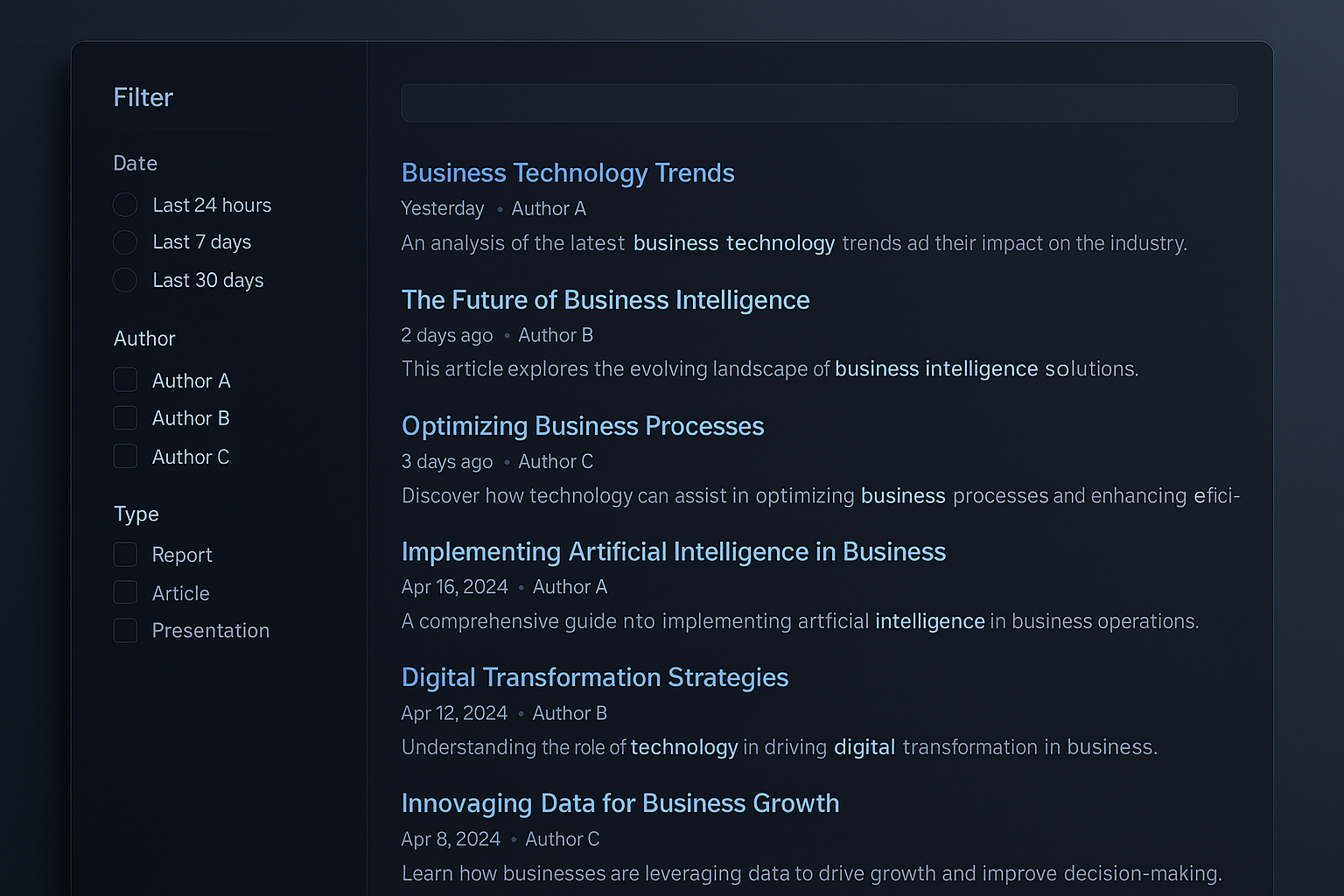
Where conversational search can fail (and why old lessons help)
- Hallucination and trust: generated answers can confidently state incorrect facts unless grounded in sources.
- Loss of control: removing visible filters or result lists can make it hard to narrow or verify results.
- Ambiguity and precision: when an exact document or number is needed, a summary isn’t enough.
- Performance and scale: synthesis requires retrieval + generation pipelines; latency and cost can rise.
Old-school controls are practical defenses: expose filters, keep links to sources, let users switch to list mode.
What still matters from the old model
- Metadata and good indexing
- Tags, dates, authors, document types, and structured fields remain invaluable. They enable filtering, sorting, and provenance.
- Filters and explicit controls
- Users need ways to constrain results (date ranges, departments, file types). Conversational systems should surface or honor these constraints.
- Relevance signals and evaluation
- Clicks, dwell time, query reformulation paths, and manual relevance judgments still guide tuning and retraining.
- Traceability and source display
- Always show where answers come from. Source links, snippets, and confidence indicators matter for trust.
- Incremental refinement UI
- The ability to refine a query (modify keywords, add a filter) is still crucial for targeted research.
Design patterns: combining both approaches
- Dual-mode interface: let users pick "Chat" for quick summaries and "Browse" for lists and filters.
- Source-first answers: generated summaries should include a short answer + clickable sources and an option to view originals.
- Expose reasoning: provide a brief explanation of how the answer was formed (e.g., "Synthesized from 3 documents dated 2023–2024").
- Keep keyword inputs: allow advanced users to enter booleans or fielded queries; treat them as strong signals.
- Preserve analytics: log the natural language prompts and the equivalent retrieval queries to improve ranking and intent detection.

Practical implementation checklist
- Keep structured metadata in your index (don’t drop fields when adopting RAG).
- Add a clear toggle between conversational and list view in the UI.
- Require or surface source citations for any generated factual statement.
- Provide edit controls on generated answers ("show original", "view results list", "refine query").
- Monitor user behavior: if many users switch from chat to list mode, surface filters earlier.
- Implement guardrails: confidence thresholds, human review for critical answers, and overwrite prevention for actions triggered by agents.
Example workflow changes that make sense
- Knowledge worker searching policies: use chat to get a summary, then click source links and use filters to verify and cite.
- Customer support: use AI to draft an answer, then show the underlying KB articles and let the agent edit before sending.
- Product discovery: conversational queries can suggest features, but product teams should expose facets (platform, pricing tier) for final selection.
Final recommendations (practical, low-effort wins)
- Start by layering conversational search on top of your existing indexed search. Don’t rip out filters or metadata.
- Add source cards and a "view list" button to every generated answer.
- Train users with short tooltips: when to use chat, when to use filters.
- Measure: time-to-answer, source clicks, switch-to-list rate, and user satisfaction.
Takeaway
Conversational search changes how people ask questions and consume answers, but it does not remove the need for good indexing, metadata, filters, and traceability. Build systems that combine synthesis with the old guarantees: provenance, control, and measurable relevance.
Practical takeaway: deliver chat answers, but keep the list—and the filters—visible and usable by default.
